Showing posts with label Pyrometallurgy. Show all posts

Thursday, November 14, 2013

Production of High-Carbon Ferromanganese in Blast Furnace


Ferromanganese can be produced in Blast Furnace in a manner similiar to pig iron, however, in Western World only four producers employ this method. These are Thyasen Stahl (Germany), BSC Claveland (UK), SFPO (France), and Mizushima (Japan). The product produced from Blast Furnaces generally contains 76% Mn and 16% Fe.

Raw Material Selection and Pre-Treatment
The Raw materials required for the production of high-carbon ferromanganese are manganese ores, fluxes such as limestone, dolomite, or silica, and solid fuels and reductants such as coke.

In order to produce ferromanganese of the required grade a single ore seldom suitable because the desired Mn/Fe ratio of the charge determines the  Mn content of the final product. Ore from various source are therefore blended to achieve the ideal ratio and to limit the contents of the deleterious components silica, alumina, and phosphorus in the raw material mix.

The Raw material is crushed and screened to ca. 5-30 mm. Alternatively, sintered or pelletized fined ore can be used. Some deleterious components can be partially removed from the ore prior to melting by dense-medium separation or flotation. Slaging components (dolomite or limestone) can be added to the sintered or pelletized ore, which result in cost savings in the blast furnace. Partial reduction of the higher manganese oxides may also occur during sintering.

Blast Furnace Operation
In comparison to iron making, high gas temperatures are required in ferromanganese production because the reduction of manganese (II) oxide takes place at a higher temperature than is required for the reduction of wustite. This is achieved by oxygen enrichment of the hot blast or, in the case of SFPO, by heating the blast with non transferred arc plasma torches. The plasma arc increases the flame temperature from 2200 to 2800 oC and considerably reduces the coke consumption, which usually ranges from 1270 to 2000 Kg/t.

The recovey of manganese in the alloy is usually 75-85%. This is influenced by the MnO content of the slag, the slag to metal ratio, and losses in the flue gases. The MnO content of the slag is highly dependent on the basicity ration (CaO+MgO)/SiO2 (Figure 1), which can be controlled by the choice of the ore and addition of the flux. Losses to the flue gas can generally be recovered in the gas cleaning section.These materials can then be agglomerated and returned to the furnace.


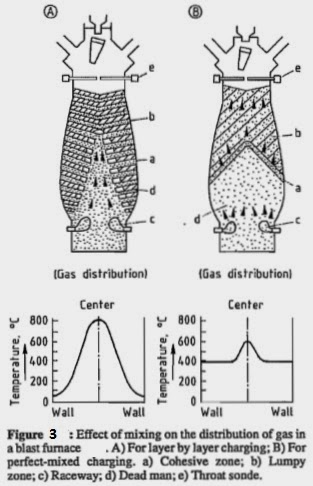
At the Mizushima work, the double bell valve of the conventional blast furnace have been replaced with an arrangement incorporating a distribution chute (figure 2). This results in a better distribution of the burden in the shaft and therefore a more even flow of gas though the burden (figure 3). The incorporation of distribution chute lowers the coke consumption of the furnace. 


In spite of innovations mentioned above the raw material costs of blast furnaces remain higher than those of submerged arc furnace due to high cost of coke. With the exception of SFPO, blast furnace production cost are higher than the average production cost of ferromanganese in electric furnaces.


The Reduction Process in The Blast Furnace
The reduction of the higher manganese oxides to manganese (II) oxide takes place in the upper zone of the shaft according to the reactions:
MnO2 + C = MnO + CO
MnO2 + CO = MnO + CO2
These generally occur below 900 oC and are indirect. The reactions are exothermic and the heat generated causes high top temperatures and necessitates water cooling of the furnace top.

The reduction of manganese (II) oxide MnO + C = Mn + CO is highly endothermic, in contrast to weakly endothermic reduction of wustite. This requires higher temperatures and, consequently, higher coke rates are required for the smelting of ferromanganese in blast furnaces.

Friday, November 1, 2013

Ferromanganese


Manganese in the world can be found as various black minerals such as Pyrolusite (MnO2).


A number of manganese-containing ferroalloys are manufactured which are used largely in the mild steel, foundry, and stainless steel industries. The names and typical compositions of these alloys are given in Table 1, and the international standards for the most commonly used alloys, namely-high carbon ferromanganese HC FeMn and silico-manganese FeSiMn, are given in the table 2. There are generally classified as intermediate products, and the range of their end uses is shown in figure 1.


Generally, high-carbon ferromanganese and silicomanganese are produced from a blend of manganese-containing ores, and in the case of siliconmanganese, slag and silica are added. Ferromanganese can be produced in either electric submerged furnaces or blast furnaces, although only 4 (four) blast furnace producer exist in the wesgtern world, whereas silicomanganese is largely produced in submerged arc furnaces. Producers of high carbon ferromanganese and silicomanganese are listed in the table 3.

High carbon ferromanganese can be converted to medium-carbon manganese by an oxigen blowing process, and silicomanganese can be further refined into medium or low-carbon ferromanganese as well as manganese metal (figure 2).


Reference: Habashi, "Handbook of Extractive Metallurgy Volume I".


Friday, October 25, 2013

Steelmaking


Steel is The Iron that contain the Carbon lower than 1,7%, as figure 1.


Steel is very important for our life, more than 95% of the equipment is made of steel. In line with the increasing demand for steel, the main raw material requirements and support: Alloy, Refractory, Flux, Spare Parts, Energy etc. will also increase.

The material requirements for steelmaking can be seen as figure 2.


Figure 2. The Material Requirements of Steelmaking


The continous process of steelmaking can be seen as figure 3.


Figure 3. The Process of Steelmaking
 
 
The most important processes in the manufacture of steel is how to maintain the properties of steel produced. So, maintaining the composition by adjusting the impurity content is very important. Impurities are usually controlled, Sulfur, Phosphor, Silicon, as well as gas and other alloy material if used.


Desulfurization
 

In absence of carbon, silicon and aluminium in metal, the desulphurization reaction can be written as:
 
[S] + [Fe] + (CaO) = (CaS) + (FeO)
 
 
Sulphur distribution ratio will be higher if:
 

aCaO is high (higher basicity)
aFeO is low (reducing slag)

k‘ is high (higher temperature)

 
Figure 4. Melt and Slag in The Laddle ( From Dr. Ing. Zulfiadi Zulhan)
 

Figure 5. Bottom stirring of Desulphurization Process


Desiliconization
Silicon in metal is oxidized to SiO2, the reaction taking place is:
[Si] + 2[O] = (SiO2)
The partitioning between slag and metal will depend upond the activities of silicon and oxygen in metal and on the the activity of silica in slag
[Si] + 2[O] = (SiO2)
 
Dephosphorization
 
Phosphor in metal is oxidized to P2O5, the reaction taking place is:
2[P] + 5[O] = (P2O5)
The partitioning between slag and metal will depend upond the activities of Phosphorus Pentoxide and oxygen in metal and on the the activity of Phospor in slag
2[P] + 5[O] = (P2O5)


Desulphurization need Reductive Environment, but the Desiliconization and Dephosphorization need Oxidative Environment. Degassing is done with vacuum condition.


Friday, October 11, 2013

Sponge Iron Making


The process of sponge iron manufacturing involves removal of oxygen from iron ore. When that happens, the departing oxygen causes micro pores in the ore body, turning it porous. When the eventual product is observed under a microscope, it resembles a honeycomb structure, which looks spongy in texture. Hence the name sponge iron.
 
The Main Raw Material are Primary ore Secondary Iron Ore (Magnetite or Hematite),  Iron sand also can be used but it should be a Pellet first. Beside that Non Cooking Coal for reduction and sometimes dolomite or Lime is needed to fix the Sulfur and or bacisity.

Fig 1. Example for Specification of Iron Ore


Fig 2. Rotary Kiln Cross Section
 

Coal based Direct reduction process is classified based on the reducing agent namely solid. Most solid reduction process use non-coking coal as reducing agent due to abundantly available non-coking coal. The process proposed to be adopted is the rotary kiln proposes using Non-coking coal and iron ore. Iron are undergoes the following reduction reaction in all the processes.


Based on Fig 3. seen that the reaction start at Temperature around 700 oC with 60% of CO at 1 atm. But Normally, the process is done at temperature 900-1100 oC.


Fig 3. Iron and Boudouard reaction Diagram


After processed in rotary kiln, the product sponge iron come to the water cooled cooler where its temperature reaches to 80 to 100°C. The Product is conveyed to the product separation and storage building.


Fig 4. Example of Spong Iron Specification


The Example of the Complete Flowsheet can be seen as figure 5.
 
 
Fig. 5 Process Flowsheet


Monday, September 23, 2013

Magnesium Extraction By Magnetherm Process


This technology was developed in the 1950s and 1960s by the large aluminum production company Pechiney. Later, it was also used by Northwest Alloys in the United States (see Fig. 1). The main characteristic of this technology is the heating and production furnace in which the heating takes place with electrodes using alternating current. Such heating requires liquid slag, which will conduct electricity, and therefore, in addition to Dolomite, which has undergone calcination and in addition to the reduction silicon, alumina is also added. Figure 2 describes the furnace and its components, schematically.
 
The furnace in the Magnetherm process operates within a temperature range of 1,300–1,700°C. This high temperature range stems from a number of reasons and variations in the process. The first reason is the difficulty in maintaining low pressures in the furnace with a large volume, and, therefore, as can be seen from reaction (1) :
 
2MgO*CaO(s) + Si (Fe)  =  2Mg(g) + Ca2SiO4(l) + Fe                            (1)
P = 1 at’ ; T = 1,700°C or P = 1 mm Hg ; T = 1,150–,200°C
 
it is necessary to work at higher temperatures. At times a certain quantity of magnesite,which has undergone calcination, is also added, to increase the reaction temperature.Another variation of the process that can also influence the temperature is the addition of metallic aluminum as an alternative to silicon. The use of aluminum in these processes will be detailed in the aluminothermic processes.

Production in a furnace with the Magnetherm process is in batch form and a complete cycle lasts normally 16–24 h. The magnesium fumes rise and accumulate in the cooled condenser in the liquid or solid state. The furnace usually produces between 3 and 8 t of magnesium a day, according to its size. As a rule, 7 t of raw material are required in order to produce 1 t of magnesium.


Fig. 1. Magnetherm Flow Chart Process


Fig. 2. The Magnetherm Production Facilities


Thursday, September 19, 2013

Magnesium Extraction By Pidgeon Process


This process was developed in the 1940s in Ontario Canada,by Prof.Pidgeon and the Timminco company. Lately, this process has received new attention and constitutes a central process in the magnesium production at a large number of Chinese manufacturers (see Figs. 1 and 2).

The reaction that takes place is reaction below (Eqs. 1):
 
2MgO*CaO(s) + Si (Fe)  = 2Mg(g) + Ca2SiO4(l) + Fe                            (1)
P = 1 at’ ; T = 1,700°C or P = 1 mm Hg ; T = 1,150–,200°C
 
A schematic illustration of the retort used in this process is shown in Fig. 2. The dimensions of the retort are 2.7–3.3 m with a diameter of 28–35 cm. The capacity of the retort is about 120 kg.
 
The source of energy in the process carried out in China is normally coal, while the calcination process and the heating furnaces require 14–20 t of coal for the production of one ton of magnesium.
 
On completion of the process a magnesium crown is obtained, weighing 12–20 kg,which is then extracted from the upper part of the retort. Due to the usually high temperature, the magnesium in this case will contain high concentrations of aluminum,manganese, iron and other impurities. The above process can also be carried out with magnesite as an alternative to dolomite; the working conditions are almost identical and the reaction in this case is Eq. (2).
 
 
4MgO(s) + Si(Fe)  = 2Mg(g) + Mg2SiO2(s) + Fe                            (2)
P = 10 mm Hg ; T = 1,220°C

2MgO(s) + Si(Fe)  = 2Mg(g) + SiO2(l) + Fe                                   (3)
P = 1 at’ ; T = 2,300°C or P = 1 mm Hg ; T = 1,500°C

Another version of the above process is carried out at a higher temperature, according to the reaction appearing in Eq. (3). The advantage of this reaction is the higher output from each retort (up to about 80%),while the disadvantages in this case are many. The main one being the higher temperature required for the process, 1,500°C, about 300°C more than with the regular process.Work at a higher temperature usually causes the evaporation of impurities and a lower quality of material. In addition, there is accelerated amortization of tools, and this in addition to the higher cost of energy and the need for accessibility to magnesite.


Fig. 1. Pidgeon Process


Fig. 2. A Retort Used In The Pigeon Process


Monday, September 16, 2013

Magnesium Extraction By Thermal Reduction Methods


The only ores used in the production of magnesium with thermal reduction technology are dolomite and magnesite. These ores are extracted through customary mining methods, mainly through open mining.The ore extracted from the mine undergoes calcination at temperatures of 700–1,000°C. At this temperature the material releases COgas, according to Eqs. (1) and (2), for magnesite and dolomite, respectively:

 
MgCO3(s)  = MgO(s) + CO2(g)           (1)

MgCO3*CaCO3(s)  = MgO*CaO(s) + 2CO2(g)             (2)
 
 Following calcination the material is ground into a fine powder.


Another main raw material that is used in thermal reduction is an alloy of silicon and iron called Ferrosilicon. The silicon content in this alloy is 65–85%, and at times the mix also contains small quantities of aluminum. The preparation of the ferrosilicon is carried out by reducing silica with coal, containing iron (scrap iron), at high temperatures:

SiO2(s) + 2C(s) + Fe = Si(Fe)(s) + 2CO(g)                      (3)
 
An additional material,which was used in the past as a thermal reduction agent, is Calcium carbide. The process of preparation of this material is relatively simple, but it requires high temperatures of about 1,800–2,000°C. Below is the reaction used in the production of this material:
 

CaO(s) + 3C(s)  = CaC2(s) + CO(g)                              (4)


Another raw material used in the magnetherm process is bauxite. This material undergoes calcination at temperatures of about 1,200°C before it is introduced into reaction, according to Eq. (5):

 
Al2O3*nH2O(s)  = Al2O3(s) + nH2O(g)                        (5)


Additional raw materials used as additives or reduction agents, such as aluminum, alumina and coal usually undergo grinding or chipping only.
 
The heating and reduction processes differ between thermal technologies,with thermodynamics eventually determining the reaction temperature. The thermodynamics of the reduction reaction depends on reactants, products and reaction conditions, such as pressure, temperature and the presence of other additives. The reactions described below are organized according to the reducing material used.


Silicothermic Processes


These processes are the main and almost the only thermal processes by which magnesium is produced commercially. In general, this category contains three main processes,which differ mainly in the manner of heating.Following are the main reactions of these processes at different temperatures and pressures:


2MgO(s) + Si(Fe)  = 2Mg(g) + SiO2(l) + Fe                                            (6)
P = 1 at’ ; T = 2,300°C or P = 1 mm Hg ; T = 1,500°C

4MgO(s) + Si(Fe)  = 2Mg(g) + Mg2SiO2(s) + Fe                                     (7)
P = 10 mm Hg ; T = 1,220°C
 
2MgO*CaO(s) + Si (Fe)  = 2Mg(g) + Ca2SiO4(l) + Fe                            (8)
P = 1 at’ ; T = 1,700°C or P = 1 mm Hg ; T = 1,150–,200°C


Aluminothermic Processes
In this process, aluminum serves as the reduction material for the production of magnesium. In the main reaction, the reduction of dolomite is carried out with aluminum (with the addition of some magnesite) that has undergone calcination as shown in Eq. (9):

3MgO(s) + 2CaO(s) + 2Al(l)  = 3Mg(g) + 2CaO*Al2O3(s)                                   (9)
P = 1 at’ ; T = 1,300°C or P = 10 mm Hg ; T = 900°C

The advantages of this process are many, and they stem mainly from the fact that the reaction is carried out at a relatively low temperature, which is, in fact, the lowest of all the thermal processes. The main disadvantage of the process is in the high cost of aluminum,and therefore, the only process in which aluminum serves as a partial reduction agent is the magnetherm process. Hence it is usually operated by companies that also own very large aluminum plants. These companies generally also manufacture (as a by-product) large quantities of aluminum scrap and aluminum rich waste which can be used for this process.
 
An innovative process which is based on this reaction, is the Heggie, which is described in Fig. 1. The process is based on the use of Dolomite and magnesite that have undergone calcination, and aluminum scrap as reduction material. The furnace used is the Heggie process and works according to the working principles of the DC transferred arc plasma furnace. This process is supposed to work at atmospheric pressure and under argon atmosphere at temperatures of about 1,500°C. The way the Heggie furnace works enables the relatively high work temperature to exist only in a restricted area of the electric arc. The developers of the process claim that the Heggie furnace consumes only 6 kWh in order to manufacture 1 kg of magnesium.
 
 
Fig. 1. Heggie Process